
 Posted by
 Introduction
The human body looks simple from the outside, but inside it works like a strong and flexible machine. One of the most important parts of this machine is the skeletal system. Without bones, the human body would have no shape, no strength, and no support.
Bones protect vital organs, help us move, store minerals, and produce blood cells. Understanding the types of bones in human body helps students, patients, fitness lovers, and health readers learn how the body stays strong and balanced.
What Are Bones and Why Are They Important?
Bones are hard, living tissues that form the skeleton of the body. They grow, repair themselves, and change over time. Bones do not stay lifeless; they stay active throughout life.
Bones help the human body in many ways:
- They give shape and structure
- They protect organs like the brain and heart
- They allow movement with the help of muscles
- They store calcium and phosphorus
- They produce blood cells inside bone marrow
Without bones, joints in human body would not work, and movement would not exist.
How Many Bones Are in the Human Body?
One of the most common questions is: how many bones are in the human body?
Total Number of Bones in Human Body
An adult human body has 206 bones.
However:
- Babies are born with about 300 bones
- Many bones fuse together as the body grows
- This fusion leads to the total number of bones in human body becoming 206 in adults
So, the answer to how many bones are in the human body is:
👉 206 bones in adults
Human Body Bones Name: Major Bone Groups
To understand the bones name of human body, doctors divide the skeleton into two main parts:
1. Axial Skeleton
2. Appendicular Skeleton
Together, they form the complete skeletal system.
Axial Skeleton: Central Support System
The axial skeleton forms the central axis of the body. It protects vital organs and supports posture.
Bones Included in Axial Skeleton
- Skull
- Vertebral column (spine)
- Rib cage
- Sternum
The axial skeleton has 80 bones.
Skull: Bones of the Head
The skull protects the brain and forms the structure of the face.
Human body bones name in skull include:
- Frontal bone
- Parietal bones
- Temporal bones
- Occipital bone
- Nasal bone
- Maxilla
- Mandible
The skull has 22 bones.
Vertebral Column (Spine)
The spine supports the body and protects the spinal cord.
Bones name of human body in spine:
- Cervical vertebrae (7)
- Thoracic vertebrae (12)
- Lumbar vertebrae (5)
- Sacrum
- Coccyx
Total bones in the vertebral column: 26
Rib Cage
The rib cage protects the heart and lungs.
It includes:
- 12 pairs of ribs (24 bones)
- Sternum (breastbone)
Appendicular Skeleton: Movement System
The appendicular skeleton helps in movement and flexibility. It includes limbs and joints.
This system contains 126 bones.
Upper Limb Bones
These bones help in lifting, writing, and holding objects.
Names of bones in human body (upper limb):
- Clavicle
- Scapula
- Humerus
- Radius
- Ulna
- Carpals
- Metacarpals
- Phalanges
Each arm contains 30 bones.
Lower Limb Bones
These bones support body weight and help in walking and running.
Human body bones name (lower limb):
- Femur
- Patella
- Tibia
- Fibula
- Tarsals
- Metatarsals
- Phalanges
Each leg contains 30 bones.
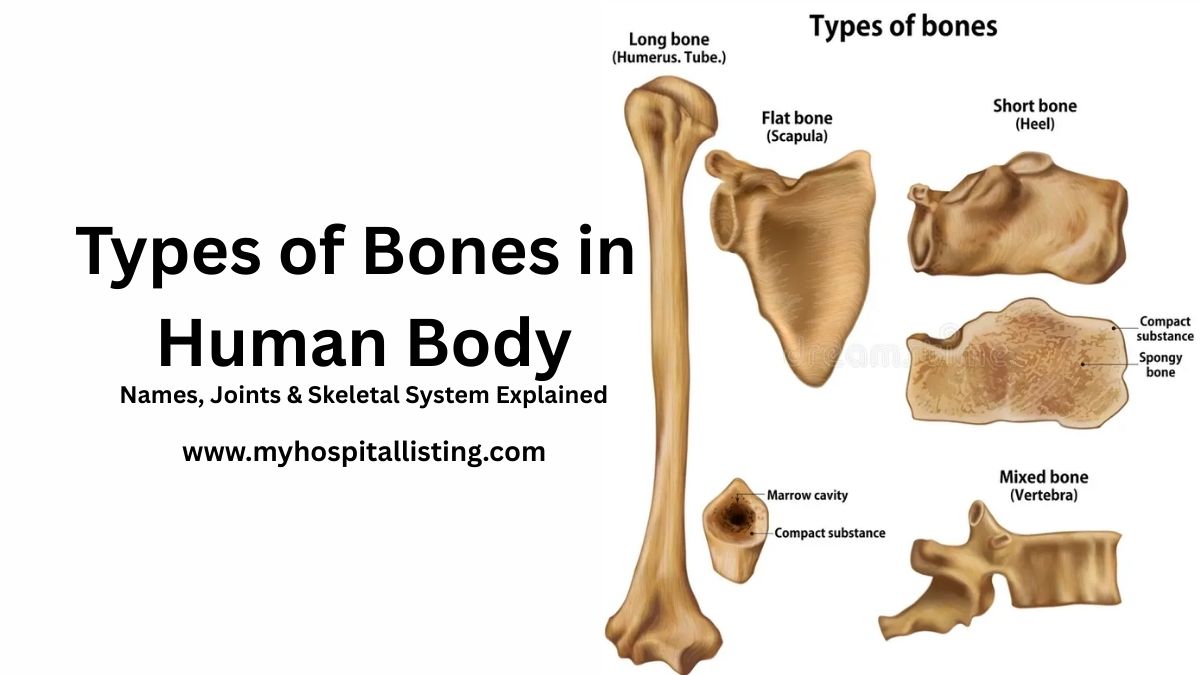
Types of Bones in Human Body
Doctors classify bones based on shape and function. Understanding the types of bones makes learning anatomy easier.
There are five main types of bones in human body.
1. Long Bones
Long bones are longer than they are wide. They help in movement and support body weight.
Examples of Long Bones
- Femur
- Humerus
- Tibia
- Fibula
- Radius
- Ulna
These bones play a key role in joints of human body like knees and elbows.
2. Short Bones
Short bones are small and cube-shaped. They provide stability and limited movement.
Examples
- Carpals (wrist bones)
- Tarsals (ankle bones)
Short bones support balance and posture.
3. Flat Bones
Flat bones protect internal organs and provide a surface for muscle attachment.
Examples
- Skull bones
- Sternum
- Ribs
- Scapula
Flat bones protect the brain, heart, and lungs.
4. Irregular Bones
Irregular bones have complex shapes.
Examples
- Vertebrae
- Facial bones
- Hip bones
They protect nerves and support posture.
5. Sesamoid Bones
These bones develop inside tendons.
Example
-
Patella (kneecap)
Sesamoid bones reduce friction and improve joint movement.
Diagram of Skeletal System (Explained in Words)
A diagram of skeletal system shows how bones connect inside the body.
The diagram usually displays:
- Skull at the top
- Spine in the center
- Rib cage around the chest
- Arm bones on both sides
- Leg bones below
Understanding the diagram of skeletal system helps students identify names of bones in human body easily.
Joints in Human Body: Connecting the Bones
Bones cannot move alone. Joints in human body connect bones and allow movement.
What Are Joints?
Joints are points where two or more bones meet.
Types of Joints of Human Body
There are three main types of joints of human body.
1. Fibrous Joints
These joints do not allow movement.
Example:
-
Skull joints
2. Cartilaginous Joints
These joints allow limited movement.
Example:
-
Joints between vertebrae
3. Synovial Joints
These joints allow free movement.
Examples of human body joints:
- Shoulder joint
- Knee joint
- Hip joint
- Elbow joint
Synovial joints help in walking, running, and lifting.
Importance of Joints in Human Body
Joints help the body:
- Bend and rotate
- Walk and run
- Sit and stand
- Perform daily tasks
Without joints in human body, movement would not exist.
Bone Health: Why Strong Bones Matter
Healthy bones reduce the risk of fractures and joint pain.
Tips for Healthy Bones
- Eat calcium-rich foods
- Get enough vitamin D
- Exercise regularly
- Avoid smoking
- Maintain healthy weight
Strong bones support healthy joints of human body.
Common Bone Problems
Some common bone conditions include:
- Osteoporosis
- Arthritis
- Fractures
- Bone infections
Early diagnosis improves bone health.
Role of Bones at Different Life Stages
Childhood
Bones grow rapidly and need nutrition.
Adulthood
Bones maintain strength and density.
Old Age
Bone density reduces, increasing fracture risk.
Understanding types of bones in human body helps in prevention.
Summary: Types of Bones in Human Body
Let us quickly revise:
- Adult human body has 206 bones
- Bones fall into five major types
- Joints connect bones and allow movement
- Diagram of skeletal system helps visualize structure
- Bone care is essential at every age
Frequently Asked Questions (FAQs)
1. How many bones are in the human body?
An adult human body has 206 bones. Babies are born with around 300 bones, which later fuse as they grow.
2. What are the main types of bones in human body?
There are five main types of bones in human body:
long bones, short bones, flat bones, irregular bones, and sesamoid bones.
3. What are some common human body bones name?
Common human body bones name include skull, femur, humerus, tibia, fibula, ribs, vertebrae, and pelvis.
4. Why are bones important for the human body?
Bones give shape, protect organs, help movement, store minerals, and produce blood cells. Without bones, the body cannot function properly.
5. What is the total number of bones in human body including joints?
The total number of bones in human body remains 206 in adults. Joints connect bones but are not counted as bones themselves.
6. What are joints in human body?
Joints in human body are places where two or more bones meet. They help the body move, bend, and rotate smoothly.
7. How many types of joints of human body are there?
There are three types of joints of human body: fibrous joints, cartilaginous joints, and synovial joints.
8. What is the largest bone in the human body?
The femur (thigh bone) is the largest and strongest bone in the human body.
9. Why is a diagram of skeletal system important for learning?
A diagram of skeletal system helps students easily understand the structure, position, and names of bones in human body.
10. How can we keep bones and joints healthy?
You can keep bones healthy by eating calcium-rich foods, getting vitamin D, exercising regularly, and maintaining a healthy lifestyle.
Final Thoughts
Bones form the foundation of the human body. Learning about the types of bones, bones name of human body, human body joints, and total number of bones in human body helps everyone understand how the body works.
This knowledge supports better health decisions, fitness planning, and medical awareness.